Is Sidi Bou Said Worth Visiting?
What Sidi Bou Said is actually like, why it is blue and white, how crowded it gets, what to eat, and when it is worth going out of your way for.
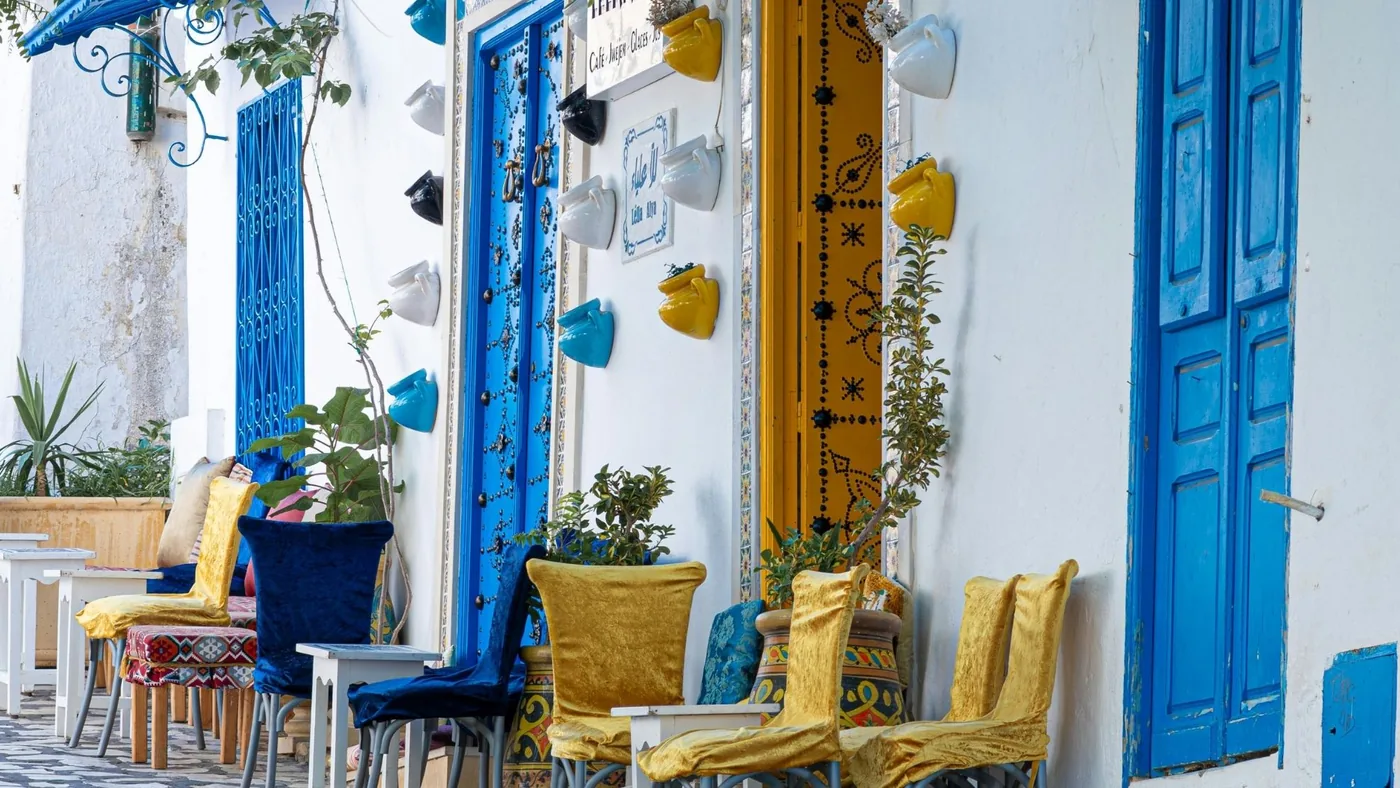
Yes, with a caveat about timing. Sidi Bou Said is a genuinely beautiful hill village with one of the best views in Tunisia, and its main street between ten in the morning and four in the afternoon is a souvenir bazaar with a coach park attached. Both descriptions are accurate. Which one you experience depends almost entirely on when you arrive.
Check Availability
What is actually there
A village of about six thousand people on a cliff above the Gulf of Tunis, five kilometres from Carthage. White walls, blue doors, blue window grilles, bougainvillea. A cobbled main street climbing from the car park to a viewpoint at the top, with quieter lanes running off it. At the summit, cafés with terraces looking down over the marina and out to the Cap Bon peninsula.
That is the whole of it. It is small, and small is part of the appeal: you can walk it in an hour without a map and without missing anything.
Why it is blue and white
The colour scheme is not ancient, which surprises people. The village grew around the shrine of a thirteenth-century Sufi saint, Abu Said al-Baji, who gave it his name. The blue-and-white palette was formalised in the early twentieth century by Rodolphe d’Erlanger, a French-born baron and painter who settled here, built the palace of Ennejma Ezzahra below the village, and campaigned for an architectural code preserving the white walls and the particular shade of blue.
His house is now a museum of Arab and Mediterranean music and it is the best thing in Sidi Bou Said that most visitors walk straight past. The studded doors — geometric patterns of black nails on blue timber — are Andalusian in origin, carried across by families expelled from Spain.
Knowing the colour was a design decision does not make it less striking. It does explain why the village looks more coherent than an organically grown settlement usually does.
The honest case against
The main street is commercial. Ceramics from Nabeul, carpets from Kairouan, stuffed camels, perfume. Prices are aimed at visitors and the sellers are persistent without being aggressive. If you dislike running that gauntlet, you will dislike the first ten minutes.
It gets very busy. Coaches from Hammamet and Sousse arrive late morning and cruise groups from La Goulette arrive with them. On a summer midday the main street moves at a shuffle.
The famous café is not the best one. Café des Nattes at the top of the steps is the one in every photograph, and it trades on that. The terraces further along the cliff have better views and fewer people.
Two hours is genuinely enough. Any tour selling you four hours here is padding, unless lunch is included.
The case for
The view. From the top of the village the entire Gulf of Tunis opens out, with the marina directly below and Cap Bon across the water. It is worth the climb on its own.
The side lanes are empty. Ten metres off the main street the crowd disappears and you are in a residential village with cats, potted geraniums and doorways. This is the part people remember.
Early and late are different places. Before nine in the morning or after five in the afternoon, Sidi Bou Said is quiet, the light is better, and the shopkeepers are opening or closing rather than selling.
The food ritual is real. Mint tea with pine nuts floating on top, drunk on a terrace, and a bambalouni — a sugared doughnut fried to order at the stall near the bottom of the main street, handed over in paper and eaten immediately. Neither is a tourist invention.
When to go, and how
If you are on a combined tour you do not get to choose; most arrive in the late morning or early afternoon, which is the busiest window. That is a fair trade for having Carthage handled.
If you can choose, go at the beginning or the end of the day. Staying in Tunis, that is easy: the TGM commuter train runs to the village for well under a dinar, every ten to twenty minutes, from four in the morning until one at night. Our guide to getting there without a car has the stations.
From the Hammamet coast there is a half-day transfer that visits the village alone for around $24, giving you two hours on the ground with no ruins on the itinerary. It is the right booking if archaeology is not why you came, and there is also a sunset version for the light.
Is it a tourist trap?
Not in the sense the phrase usually means. Nothing here is fake, nobody is charging twenty dollars for a photograph with a camel, and the village was beautiful long before anyone sold a plate in it. It is a real place that a lot of people visit, which is a different thing.
The trap, if there is one, is arriving at noon with a coach, spending your two hours on the main street, buying a ceramic bowl and leaving with the impression that the whole village is a shop. Walk one lane over and it is not.
Frequently asked questions
Is Sidi Bou Said worth visiting?
Yes. It is a small, genuinely beautiful cliff village with an outstanding view over the Gulf of Tunis, and it pairs naturally with Carthage five kilometres away. Go early or late if you can, because the main street is crowded between mid-morning and late afternoon.
How long should I spend in Sidi Bou Said?
One to two hours. An hour walks the village; two hours walks it, climbs to the viewpoint and leaves time to sit down with a mint tea. Longer only pays off if you are having lunch or waiting for the evening light.
Why is Sidi Bou Said blue and white?
The palette was formalised in the early twentieth century by the French-born baron Rodolphe d’Erlanger, who lived there and pushed for an architectural code preserving white walls and a specific blue. The village itself is far older, grown around the shrine of a thirteenth-century Sufi saint.
What should I eat in Sidi Bou Said?
Mint tea with pine nuts, drunk on a terrace, and a bambalouni — a sugared doughnut fried to order at the stall near the bottom of the main street. Both are local rituals rather than tourist inventions.
Is Sidi Bou Said expensive?
The village is more expensive than the rest of Tunisia, which is to say still inexpensive by European standards. Tea on a cliff terrace and a doughnut cost a few dinars. Ceramics and carpets are priced for visitors, and haggling is expected.
Can you visit Sidi Bou Said without visiting Carthage?
Easily. The TGM train stops in both, so you can skip one, and there is a half-day transfer from the Hammamet coast that goes to the village alone. Given they are ten minutes apart, most people do both.
Is Sidi Bou Said good for photography?
Very, and it is one of the most photographed places in North Africa for good reason. Early morning gives you empty streets; late afternoon gives you the light on the white walls and the sea. Midday gives you crowds and hard shadows.
Want the village without the driving? Compare tours that include Sidi Bou Said or check availability for your dates.
See Carthage and Sidi Bou Said in One Day
Pickup from Tunis, Hammamet, Sousse or the cruise port, a licensed guide at the ruins, and free time in the blue village. Most tours cancel free up to 24 hours ahead.
Check Availability & Book