Best Things to Do in Carthage
The best things to do in Carthage: the Antonine Baths, Byrsa Hill, the Punic Ports, the Tophet, the Roman villas and more, which sites to pick on a short visit, and how to finish in Sidi Bou Said.
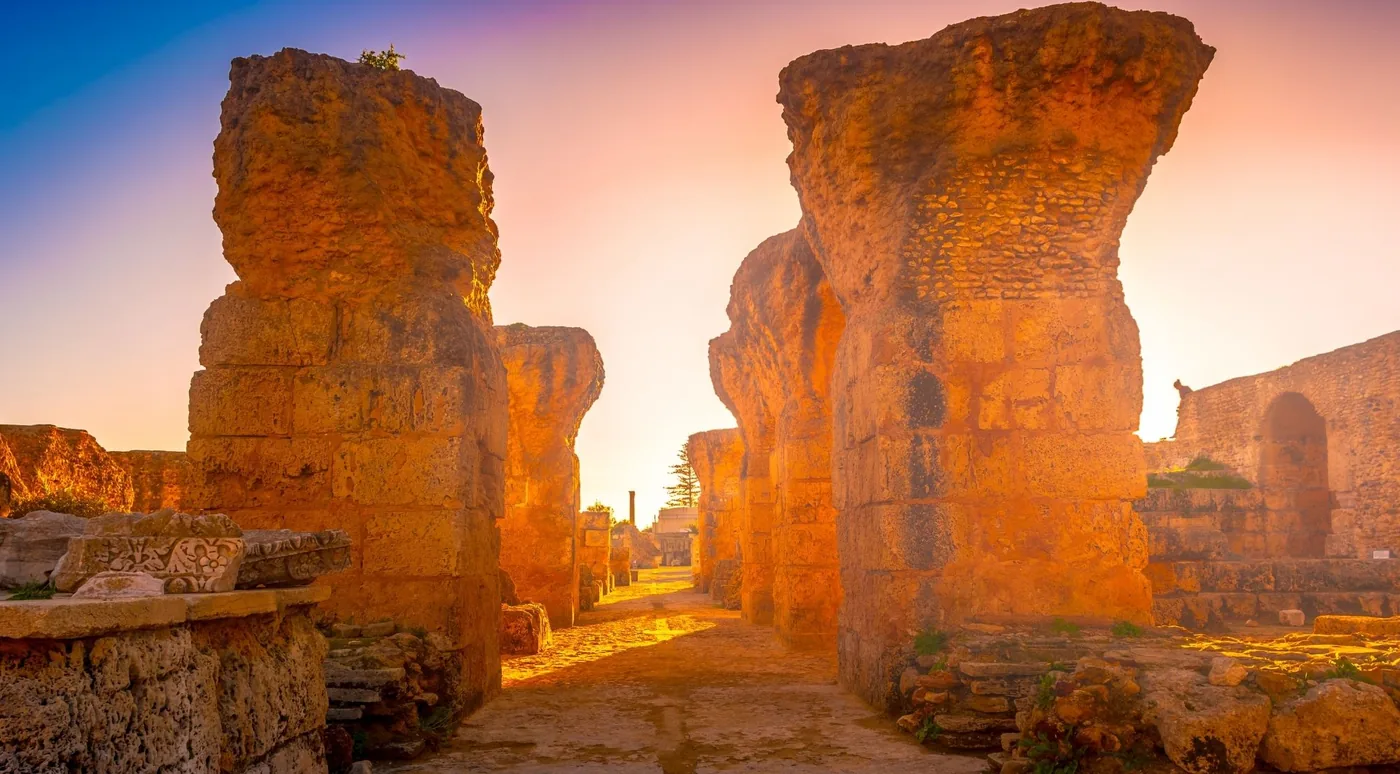
Carthage is not one attraction. The ancient city is spread across a modern suburb of Tunis, with separate archaeological sites between houses, villas and roads. On a first visit, pick three or four sites from different periods, take a guide if the history matters to you, and finish the day in Sidi Bou Said.
Check Availability
The first four sites below give you the clearest picture of Punic and Roman Carthage. The rest suit a longer day or a particular interest.
1. Antonine Baths
Start here for monumental Roman ruins and immediate visual impact. The baths were among the largest in the Roman world, set right on the seafront, and the scale of the surviving vaults and columns is clear the moment you walk in. The Mediterranean behind them makes this the most photographed site in Carthage.
2. Byrsa Hill
Go up Byrsa Hill for historical context and to understand the geography of ancient Carthage. This was the citadel of the Punic city, and from the top you can see how the harbours, the coast and the later Roman grid fit together. Remains of Punic houses survive on the slope, and the hill is also where you find the Carthage Museum and the former St Louis Cathedral.
3. Punic Ports
Come to the Punic Ports for Hannibal, maritime power and Punic history. Two lagoons survive from the ancient harbours: a rectangular commercial port and a circular military harbour with a small island at its centre, where the city’s war fleet was housed. There is little standing masonry, so a guide or a good plan of the harbour makes a big difference here.
4. Tophet
The Tophet covers Punic archaeology and religious history. It is a sanctuary where urns holding the cremated remains of infants and young animals were buried under carved stone markers over several centuries. Historians still debate what the burials mean. The site is small, shaded and quiet, and it is the oldest layer of Carthage you can visit.
5. Roman Villas
The Roman Villas give you a deeper look at domestic life in Roman Carthage. The park on the hillside holds the remains of wealthy houses with mosaic floors, and the restored Villa of the Aviary is the highlight. Add it if you have seen the baths and want to know how the people who used them lived.
6. Roman Theatre
The Roman Theatre suits Roman-history enthusiasts. Much of the seating has been restored, and the theatre is still used for summer performances during the Carthage International Festival. It sits close to the Roman Villas, so the two pair easily.
7. Amphitheatre
The amphitheatre is historically significant but optional on a short first visit. It once held tens of thousands of spectators, and early Christian martyrs were killed here, but little of the structure survives above ground and it lies away from the main cluster of sites.
8. Maalga Cisterns
The Maalga Cisterns show Roman engineering. These huge vaulted reservoirs stored water brought to Carthage by the aqueduct from Zaghouan, far to the south. They are off the usual circuit and easiest to reach with a driver or a guide who knows the way.
9. Check the Carthage Museum status
The Carthage Museum on Byrsa Hill has had restructuring and renovation closures, and access has changed more than once. Check current opening before you plan your day around it. Our Carthage tickets and ruins guide covers how site entry works.
10. Learn the history first
A little background makes the ruins far more rewarding. Know the outline before you go: Phoenician settlers founded Carthage, it fought Rome in the Punic Wars, Rome destroyed the city in 146 BC, and Rome later rebuilt it as the capital of the province of Africa. Most of what you see above ground is Roman, built on top of the Punic city. Read our guide to what to see in Carthage for a route through the sites.
11. Take a guide if history matters
Carthage is one of the places where a guide can change your visit. Signs at the sites are sparse, and much of the Punic city survives only as foundations, so a guide who can explain what stood where turns rubble into a city.
The Carthage walking tour of the archaeological sites ($88 per person, 4.8/5 from 46 reviews) spends three hours on foot across seven sites, including the Tophet, the Punic Ports, the Antonine Baths, the Roman villas and Byrsa Hill, with entry tickets included. It starts near Salammbo station on the TGM light rail from Tunis.
12. Combine with Sidi Bou Said
For most first-time visitors, three good Carthage sites followed by Sidi Bou Said make a better day than attempting every archaeological zone. The village is a short ride from the ruins, and an afternoon of lanes, mint tea and sea views is a good end to a morning of history.
The Carthage and Sidi Bou Said Tour ($56 per person, 4.9/5 from 76 reviews) covers both: about two and a half hours at six Carthage sites with entry tickets included, then a drop-off in Sidi Bou Said. Choose it if you want both places in one booking, and the walking tour if you want more time at the ruins. Our list of the best things to do in Sidi Bou Said covers the afternoon.
Final thoughts
Do not try to complete Carthage. Choose a small number of sites that show different periods, such as the Tophet, the Punic Ports, Byrsa Hill and the Antonine Baths, and use the rest of the day for nearby Sidi Bou Said.
Three or four sites with a guide, then Sidi Bou Said, is the day that works for most first-time visitors. Compare the tours that include site entry or check availability for your dates.
See Carthage and Sidi Bou Said in One Day
Pickup from Tunis, Hammamet, Sousse or the cruise port, a licensed guide at the ruins, and free time in the blue village. Most tours cancel free up to 24 hours ahead.
Check Availability & Book